
This article examines the divergence between Luxembourg's formal political-finance rules and the practical accessibility of disclosure data, with particular attention to municipal campaign reporting and open-data standards.
It traces how international conventions and global benchmarks have prompted efforts to align Luxembourg's domestic law with international standards on political finance transparency, municipal campaign reporting, and open data accessibility. By examining the stark divergence between de jure regulatory frameworks and de facto enforcement realities, this paper exposes the structural vulnerabilities that position the Grand Duchy in the bottom third of the European Political Finance Transparency Index.
Introduction
Europe generally champions strong anti-corruption standards, but a significant gap remains between legislation and real-world enforcement. Key vulnerabilities within European political transparency systems include weak regulations surrounding revolving-door mechanisms, deficient asset-verification frameworks for public officials, and inconsistent protection frameworks for whistleblowers.
Recent controversies - most notably the Qatargate scandal involving illicit lobbying within the European Parliament - have severely shaken public trust. Furthermore, heightened geopolitical anxiety around foreign funding of national elections, as well as the erosion of judicial independence in certain countries, have made political integrity a crucial battleground for protecting democratic norms in a time of democratic backsliding.
In this context, Resolution 11/7 on Preventing and combating corruption through enhancing transparency in the funding of political parties, adopted by the United Nations Convention Against Corruption (UNCAC) in December 2025, represents a milestone. It is the first comprehensive set of global standards explicitly targeting corruption in political finance. This resolution addresses a critical global vulnerability: the corrupting influence of dark money in elections and political parties. It focuses on two core pillars:
Limits on donations, foreign funding, the abuse of state resources, and non-contestant campaigning.
Strict financial bookkeeping, regular reporting, institutional oversight, cross-border cooperation, and civil society engagement.
Importantly, the resolution outlines legal frameworks and actionable steps member states can take to support transparency at all levels, while underlining how these principles should be implemented within the UN framework. Ultimately, Resolution 11/7 provides an essential international benchmark designed to prevent illicit interference by third parties - whether organised crime groups, private corporations, or foreign governments - from manipulating democratic outcomes.
On a similar note, the Sustainable Development Goal (SDG) number 16: Peace, Justice, and Strong Institutions, serves as a vital global framework for anchoring anti-corruption and political transparency within the wider development agenda. By targeting the reduction of bribery, eliminating illicit financial flows, and building effective, accountable, and inclusive institutions, SDG 16 recognises that systemic corruption is a direct barrier to sustainable growth. Political integrity is not merely a legal checkbox; it is a foundational requirement to prevent state capture and the erosion of democratic governance structures.
Research methodology
The research presented in this paper was conducted as part of the BridgeGap project by the European Research Centre for Anti-Corruption and State-Building (ERCAS). BridgeGap conceptualises corruption as a complex policy problem, focusing on both domestic vulnerabilities and cross-border factors that undermine corruption control.
To measure political finance transparency, the project builds on established international frameworks, integrating International IDEA's work on de jure components with the Global Data Barometer's contributions to de facto aspects.
Accordingly, the assessment questionnaire used for the following research evaluates both the regulatory framework and the practical availability of political funding and expenditure data in Luxembourg. It comprises 35 questions tracking the disclosure of resources and spending, alongside the accessibility of data. The collected information underwent several stages of rigorous quality control:
- Preliminary data was shared with national experts to verify the relevance of sources, review assessment accuracy, and capture recent legislative developments.
- A formal review session was hosted to present the preliminary findings and integrate expert feedback.
The two coding questionnaires are available as pop-out tables here, so the article can continue to the bibliography without placing long technical annexes at the bottom of the page.
Political Finance Transparency Index De Jure Coding Questionnaire
Legal Framework (De Jure) Questions |
Coding Instructions |
|---|---|
Is it mandatory for political parties to report, at least annually, on their regular income? |
Code "Yes" if political parties are legally required to provide information on their permanent funding at least once a year (e.g., donations, membership fees). Code "Partially" if reporting requirements on income exist but are limited (e.g., only certain types of income must be reported, obligations apply only to parties receiving public funding). Code "No" if legislation does not require political parties to report their permanent funding, or if a source/expert confirms that no such obligation exists. Note: This question does not relate to any report, statement or disclosure about income that political parties need to make in relation to election campaigns (such as submitting certain information before or after an election date). |
Is it mandatory for political parties to report, at least annually, on their regular expenses? |
Code "Yes" if political parties legally required to provide information on their regular expenditures at least once a year (e.g., operational costs and other spending outside election periods). Code "Partially" if reporting requirements on expenses exist but are limited (e.g., only certain types of expenditures must be reported, obligations apply only to some parties). Code "No" if legislation does not require political parties to report regular expenditures, or if a source/expert confirms that no such obligation exists. Note: This question does not relate to any report, statement or disclosure about expenditures that political parties need to make in relation to election campaigns (such as submitting certain information before or after an election date). |
Is it mandatory for political parties to report on their election campaign income? |
Code "Yes" if political parties are legally required to disclose information on their campaign income (e.g., donations, contributions, loans, public subsidies). Code "Partially" if reporting requirements exist but are limited (e.g., only certain types of income must be reported, obligations apply only to some parties). Code "No" if legislation does not require political parties to report campaign income, or if a source/expert confirms no such obligation exists. |
Is it mandatory for political parties to report on their election campaign expenses? |
Code "Yes" if political parties are legally required to disclose information on their campaign expenditures (e.g., advertising, rallies, staff, logistics). Code "Partially" if reporting requirements exist but are limited (e.g., only some expenses must be reported, obligations apply only to some parties). Code "No" if legislation does not require political parties to report campaign expenditures, or if a source/expert confirms no such obligation exists. |
Is it mandatory for candidates to report on their election campaign income? |
Code "Yes" if candidates are legally required to disclose information on their campaign funding (e.g., donations, contributions, loans, public subsidies). Code "Partially" if reporting requirements exist but are limited (e.g., only certain types of income must be reported, obligations apply only to candidates in specific elections). Code "No" if legislation does not require candidates to report campaign income, or if a source/expert confirms no such obligation exists. |
Is it mandatory for candidates to report on their election campaign expenses? |
Code "Yes" if candidates are legally required to disclose information on their campaign expenditures (e.g., advertising, rallies, logistics, staff). Code "Partially" if reporting requirements exist but are limited (e.g., only some types of expenses must be reported, obligations apply only to certain candidates). Code "No" if legislation does not require candidates to report campaign expenditures, or if a source/expert confirms no such obligation exists. |
Is it mandatory for third parties need to report on their election campaign expenditures? |
Code "Yes" if third parties (e.g., advocacy groups, interest groups, unions, corporations, NGOs) are legally required to report on their election campaign expenditures. Code "Partially" if requirements exist but are limited in scope. For example, if only certain types of third parties must report (e.g., those receiving public funding), or if they are only required to disclose specific categories of expenditures. Code "No" if legislation makes no mention of third parties having to submit such financial information, or if a written source or expert confirms that no such requirements exist. Note: By third party is here meant any person or entity other than a political party or candidate, or a person acting on behalf of a party or candidate in an official capacity (such as a party official or a candidate representative) which engages in election campaigning or in spending resources in relation to an election campaign in favour of or against a political party or contestant. |
Is the online publication of reports from parties mandatory? |
Code "Yes" if legislation requires political party reports to be published online, whether through a centralized platform (e.g., electoral authority website) or by the parties themselves. Code "Partially" if only some reports are made public online (e.g., only campaign reports, only certain parties, or only partial information), whether centralized or self-published. Code "No" if political party reports are not required to be published online. |
Is the online publication of reports from candidates mandatory? |
Code "Yes" if legislation requires candidate reports to be published online, either through a centralized platform or by candidates themselves. Code "Partially" if only some reports are made public online (e.g., only certain candidates, certain types of reports, or partial disclosure), whether centralized or self-published. Code "No" if candidate reports are not required to be published online. |
Must the reports from political parties reveal the identity of donors? |
Code "Yes" if there is a requirement for political parties to report on the identity of the persons or entities that have provided donations or contributions. This could include a general provision to reveal the identity of donors or a more specific requirement to put names, address etc. of contributors in financial reports being made. Code "Partially" If only donations above a certain value have been given or if there are other limitations to when a donor's identity must be revealed and note details in an external comment. Code "No" if it is explicitly stated that political parties do not have to reveal the identity of donors, or if there are no provisions on this issue at all. |
Must the reports from candidates reveal the identity of donors? |
Code "Yes" if there is a requirement for candidates to report on the identity of the persons or entities that have provided donations or contributions. This could include a general provision to reveal the identity of donors or a more specific requirement to put names, address etc. of contributors in financial reports being made. Code "Partially" If only donations above a certain value have been given or if there are other limitations to when a donor's identity must be revealed and note details in an external comment. Code "No" if it is explicitly stated that political parties do not have to reveal the identity of donors, or if there are no provisions on this issue at all. |
Must the reports from political parties include information on itemized income? |
Code "Yes" if legislation requires party reports to include detailed, itemized information on income sources (e.g., donations, membership fees, subsidies, loans). Code "Partially" if only some types of income must be itemized (e.g., donations above a threshold, only public funding, or only certain categories). Code "No" if legislation does not require political parties to provide itemized income in their reports. |
Must the reports from candidates include information on itemized income? |
Code "Yes" if legislation requires candidate reports to include detailed, itemized information on income sources (e.g., donations, contributions, loans, public subsidies). Code "Partially" if only some types of candidate income must be itemized (e.g., donations above a threshold, or only specific categories). Code "No" if legislation does not require candidates to provide itemized income in their reports. |
Must the reports from political parties include information on itemized expenditures? |
Code "Yes" if legislation requires parties to include detailed, itemized information on expenditures (e.g., advertising, rallies, logistics, staff). Code "Partially" if only some types of expenditures must be itemized (e.g., expenses above a threshold, or only specific categories). Code "No" if it is not stated that parties must report their spending, or if it is only stated that they should report on their spending, with no mention about detailed or itemized reporting. |
Must the reports from candidates include information on itemized expenditures? |
Code "Yes" if legislation requires candidate reports to include detailed, itemized information on expenditures (e.g., advertising, rallies, logistics, staff). Code "Partially" if only some types of candidate expenditures must be itemized (e.g., above a threshold, or only specific categories). Code "No" if legislation does not require candidates to provide itemized expenditures in their reports. |
Does the law provide sanctions for failure to comply with reporting obligations? |
Code "Yes" if the law explicitly establishes sanctions (e.g., fines, loss of public funding, deregistration, or other penalties) for political parties, candidates, or third parties that fail to comply with financial reporting obligations. Code "No" if legislation does not provide any sanctions for non-compliance with reporting obligations, or if a written source or expert confirms that no such provisions exist. |
Is there a single authority responsible for publishing online the financial data of political parties and candidates? |
Code "Yes" if a single centralized body (e.g., an electoral commission, audit institution, or transparency agency) is legally mandated to publish online the financial data of both political parties and candidates. Code "Partially" if publication responsibilities are shared among multiple institutions (e.g., one for parties and another for candidates, or parties publish independently their own data), or if the centralized authority publishes only some reports (e.g., only regular or campaign-related reports). Code "No" if there is no centralized authority responsible for publishing this data online, and publication is either not required or carried out independently by parties or candidates themselves. Note: Financial data refers to both income and expenditure information, including details on the sources of funds received and the purposes for which funds are spent. This applies to both regular (non-electoral) and campaign-related finances. |
Political Finance Transparency Index De Facto Coding Questionnaire
Component |
Availability (De Facto) Questions |
Coding Instructions |
|---|---|---|
Existence |
Is there a centralized website where financial information about political parties and candidates is published? |
"Yes": If there is a centralized website where financial information about political parties and candidates is published. "Partially": If there are websites from several public entities where political financial information is published, or financial information is published on the websites of the political parties and/or candidates. "No": There are no centralized or decentralized websites where financial information about political parties and candidates is published. Note: The information should be updated to cover the year 2024. |
Extent |
Does the data cover the regular income of political parties? |
Code "Yes" if the available data fully includes information on the regular income of political parties (e.g., donations, membership fees, subsidies, loans). Code "Partially" if data exists but is limited (e.g., only some income types, only some parties, only some years). Code "No" if no data on the regular income of political parties is available. |
Extent |
Does the data cover the election campaign income of political parties? |
Code "Yes" if the available data fully includes information on the election campaign income of political parties (e.g., donations, contributions, loans, public subsidies). Code "Partially" if data exists but is limited (e.g., only some income types, only some parties, only some election cycles). Code "No" if no data on the election campaign income of political parties is available. |
Extent |
Does the data cover the regular (between elections) expenditures of political parties? |
Code "Yes" if the available data fully includes information on the regular expenditures of political parties (e.g., operational costs, salaries, logistics). Code "Partially" if data exists but is limited (e.g., only some expenditure types, only some parties, only some years). Code "No" if no data on the regular expenditures of political parties is available. |
Extent |
Does the data cover the election campaign expenditures of political parties? |
Code "Yes" if the available data fully includes information on the election campaign expenditures of political parties (e.g., advertising, rallies, logistics, staff). Code "Partially" if data exists but is limited (e.g., only some expenditure types, only some parties, only some election cycles). Code "No" if no data on the election campaign expenditures of political parties is available. |
Extent |
Does the data cover the election campaign income of candidates? |
Code "Yes" if the available data fully includes information on the election campaign income of candidates (e.g., donations, contributions, loans, public subsidies). Code "Partially" if data exists but is limited (e.g., only some income types, only some candidates, only some election cycles). Code "No" if no data on the election campaign income of candidates is available. |
Extent |
Does the data cover the election campaign expenditures of candidates? |
Code "Yes" if the available data fully includes information on the election campaign expenditures of candidates (e.g., advertising, rallies, logistics, staff). Code "Partially" if data exists but is limited (e.g., only some expenditure types, only some candidates, only some election cycles). Code "No" if no data on the election campaign expenditures of candidates is available. |
Extent |
Does the data cover sanctions applied for non-compliance with financial reporting obligations? |
Code "Yes" if the available data includes information on sanctions actually applied (e.g., fines, suspension of funding, deregistration) to political actors, candidates, or third parties for failing to comply with reporting obligations. Code "Partially" if the data includes some information on sanctions but with limitations. For example, if sanctions are documented for certain actors only, only some types of violations, or only for certain years. Code "No" if no information on applied sanctions is available, or if legislation exists but there is no data on enforcement or cases. |
Scope |
Does the data contain itemized details of financial contributions to political parties? |
Code "Yes" if the data includes itemized details of financial contributions to parties, such as donations, public funding, and membership dues, where relevant. Code "Partially" If the data is itemized with respect to some types contributions (e.g., public funding but not donations, or vice versa). "No": If the data contains no itemized information on financial contributions to candidates. |
Scope |
Does the data contain itemized details of financial contributions to candidates? |
Code "Yes" if the data includes itemized details of financial contributions to candidates, such as donations, public funding, and membership dues, where relevant. Code "Partially" If the data is itemized with respect to some types contributions (e.g., public funding but not donations, or vice versa). "No": If the data contains no itemized information on financial contributions to candidates. |
Scope |
Does the data include unique identifiers for each donor? |
Code "Yes": If the data includes unique identifiers for each donor, containing name, occupation, and place of residence. Code "Partially": If the data includes unique identifiers but only containing name; or if the data provides only partial coverage (e.g., identifiers for major donors but not all donors). Code "No": If the data does not include unique identifiers for donors. |
Scope |
Does the data contain itemized details of the spending of political parties? |
Code "Yes" if the available data includes detailed, itemized breakdowns of party expenditures (e.g., by category such as advertising, staff, logistics, events). Code "Partially" if only some expenditures are itemized (e.g., only above a threshold, only certain categories, or only for some parties). Code "No" if no itemized expenditure data for political parties is available. |
Does the data contain itemized details of the spending of candidates? |
Code "Yes" if the available data includes detailed, itemized breakdowns of candidate expenditures (e.g., by category such as advertising, rallies, logistics, staff). Code "Partially" if only some expenditures are itemized (e.g., only above a threshold, only certain categories, or only for some candidates). Code "No" if no itemized expenditure data for candidates is available. |
|
Accesibility |
Is the data publicly accessible and free of charge? |
"Yes": If the data is fully accessible to the public and available free of charge. "Partially": If the data is publicly accessible but subject to a fee; or if the data is free of charge but only partially accessible (e.g., requires registration, not all datasets are available). "No": If the data is not publicly accessible. |
Accesibility |
Is the data published in a machine-readable format? |
Code "Yes" if the data is provided in formats that allow automated processing (e.g., CSV, XML, JSON, Excel). Code "Partially" if only some data is machine-readable, while other parts are only available in non-machine-readable formats (e.g., PDF scans). Code "No" if the data is not published in machine-readable formats. |
Accesibility |
Can the data be downloaded as data files? |
Code "Yes" if the data can be directly downloaded as files (e.g., CSV, Excel, XML). Code "Partially" if only some data can be downloaded, or downloads are restricted (e.g., partial datasets, limited periods). Code "No" if the data cannot be downloaded as files. |
Accesibility |
Is the data searchable with advanced analytical functionalities? |
Code "Yes" if the platform provides advanced search or filtering options (e.g., by donor, amount, date, party, candidate) and supports analysis. Code "Partially" if search functions exist but are limited (e.g., only keyword search without filters, or only for certain types of data). Code "No" if the data cannot be searched beyond simple browsing. |
Accesibility |
Is the data is timely and updated? |
"Yes": If the data is updated regularly and published in a timely manner, reflecting the most recent reporting period according to regulation. "Partially": If the data is updated, but not consistently or with significant delays; or if only some portions of the data are current while others are outdated. "No": If the data is not updated or is significantly outdated. Note: For political parties and third parties regular reporting periods, the information should be updated to cover the year 2024. For candidates, the information must refer to the period up to at least one year after the most recent election. |
Political transparency in Luxembourg
The political finance transparency framework in Luxembourg, primarily established by the Loi du 21 décembre 2007, creates a robust normative environment for national and European political activities. However, it leaves significant transparency gaps at the local level.
This study focused specifically on the municipal elections of Luxembourg City, utilising the precise variables and questions outlined in the BridgeGap questionnaire. The research evaluates both legal requirements and practical implementation, revealing a stark contrast between high-level institutional accountability and the granular transparency required for modern democratic oversight.
The study identified three primary structural deficiencies hindering the current system:
Communal elections are not subject to the same mandatory reporting architecture as national and European campaigns, leaving local campaign finance opaque.
Balance sheets and donor lists do not provide enough granularity to map the financial profiles of local political actors or identify conflicts of interest.
Publication responsibilities are split between institutions, with data often delayed and provided as static PDFs rather than machine-readable files.
There is a profound lack of rules governing local elections, which stands in sharp contrast to the mandatory reporting requirements for national and European campaigns. Under the 2007 Law, political parties must submit annual reports detailing their regular income and expenses - including balance sheets and donor lists - for their national operations. However, these obligations do not apply to communal elections. While national parties adhere to strict reporting and online publication mandates, obligations for municipal candidates remain ambiguous or entirely absent from the legal text. Local campaigns escape these rigours, limiting public insight into the financing of local governance.
While the law mandates that parties share general balance sheets and donor lists, the level of detail is structurally insufficient. Data reveals that while direct donations are typically itemised, other revenue streams - such as membership dues - are frequently shared only as an aggregate lump sum or excluded from public disclosure entirely. Furthermore, there is no explicit legal requirement for candidates in communal or mayoral elections to provide a written, itemised disclosure of campaign income. This lack of granularity makes it difficult for oversight bodies and the public to identify potential conflicts of interest or map the financial profiles of local political actors. While donor identities are recorded for national parties, this standard is not effectively extended to individual candidates in mayoral races.
Responsibilities for publishing financial data online are fragmented between the Chamber of Deputies and the Court of Auditors. This division of labour causes coordination bottlenecks and significant delays in data availability. Because no single, centralised authority is dedicated to the digital publication and maintenance of these records, information is rarely updated in a timely manner; the assessment notes that certain digital financial archives have not seen proactive updates for decades.
This fragmentation also compromises the de facto quality of information. Without a single authority managing the digital user experience, data is published as static PDF documents rather than machine-readable formats such as CSV or Excel. This prevents researchers, journalists, and citizens from using advanced analytical tools to search, filter, or query the data for trends.
The system does not utilise unique, government-issued identifiers for donors. Consequently, the same individual or entity can appear under slightly different names across various reports, making it nearly impossible to track financial influence across multiple election cycles or different political parties. While data is technically free and publicly accessible, the lack of advanced search functionalities and prolonged update delays means transparency remains reactive rather than proactive.
Luxembourg's comparative PFTI performance
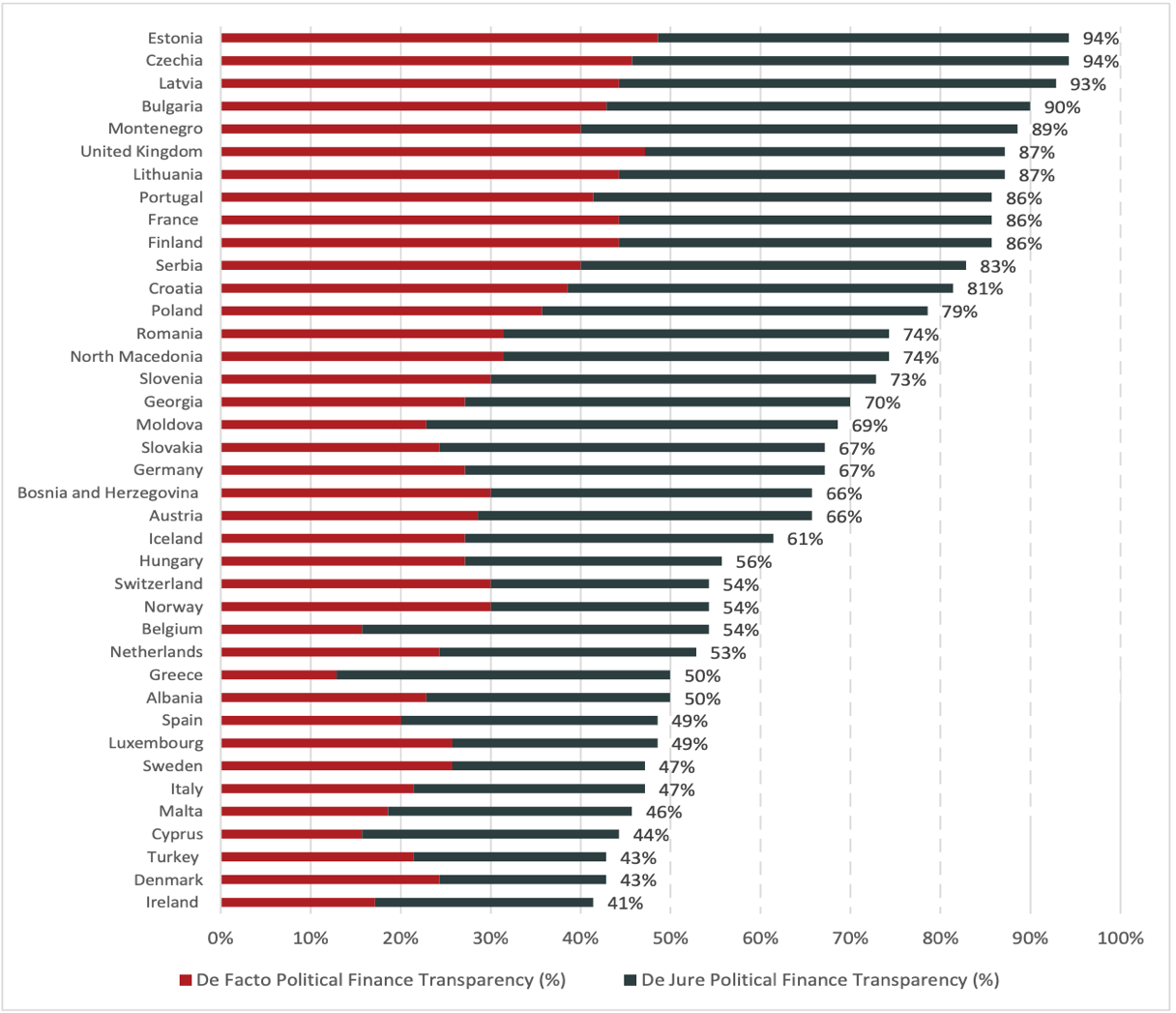
Luxembourg's performance on the Political Finance Transparency Index (PFTI) challenges the conventional assumption that the country aligns with advanced Western European governance standards. With a total fulfilment score of just 49%, Luxembourg sits in the bottom third of assessed European nations - well behind regional leaders like Estonia (94%), Czechia (94%), and Latvia (93%).
Total fulfilment score
De jure component
De facto component
Comparative European performance
Disaggregating this score reveals that its de jure component (23%) is exceptionally weak, indicating that the formal legal frameworks governing political transparency are lagging behind most of Europe. While the de facto component (26%) shows that practical disclosure slightly outpaces these minimal legal requirements, the figure remains critically low. Notably, several countries traditionally associated with institutional governance challenges, such as Bulgaria (90%), outperform Luxembourg by a wide margin. Ultimately, Luxembourg ranks alongside Albania (50%) and Italy (47%).
Conclusion
In an era marked by democratic backsliding and heightened geopolitical anxiety, protecting political integrity has transcended basic legal compliance; it is now a foundational requirement for preserving democratic governance structures. While Europe broadly champions robust anti-corruption rhetoric, the implementation gap between legislation and real-world enforcement remains a profound systemic vulnerability.
The case of Luxembourg exemplifies the sharp contrast that can exist between high-level institutional frameworks and granular transparency realities. Utilising the BridgeGap project's methodology, this research has exposed significant structural deficiencies in Luxembourg's political finance framework. A legal vacuum persists at the local governance level, where municipal and mayoral campaigns escape the rigorous reporting requirements mandated for national and European contests. Furthermore, the lack of itemised disclosures for alternative revenue streams obscures potential conflicts of interest, while institutional fragmentation between the Chamber of Deputies and the Court of Auditors delays updates and traps public data in unsearchable, static formats.
These combined domestic vulnerabilities explain Luxembourg's low performance on the Political Finance Transparency Index. If Luxembourg is to align with advanced Western European standards and actively defend its democratic institutions from undue financial influence, it must move beyond reactive transparency. It is imperative that the state:
Create a single, coherent publication point under an identified oversight responsibility.
Extend detailed reporting across all legislative levels, including municipal races.
Remove the blind spots that currently obscure the true financial profiles of political actors.
Author's biography
Silvia Gueli is an International Relations graduate specialising in international security and multilateral cooperation. She is currently completing her Master's degree in International Relations, majoring in International Security, at LUISS Guido Carli University in Rome. She holds a Bachelor's degree in International Relations and International Organization from the University of Groningen.
Silvia's professional background spans institutional analysis and diplomatic policy. She recently completed a traineeship at the Permanent Representation of Italy to the European Union in Brussels, where she supported the Middle East, Gulf, and Human Rights units. Her research centres on EU external action, institutional policy, and Middle Eastern security dynamics.
BridgeGap Project. (2026). BridgeGap D5.1: The European transparency map. CorruptionData.
Open documentChambre des Députés du Grand-Duché de Luxembourg. (n.d.). Financement des partis politiques.
Open documentChambre des Députés du Grand-Duché de Luxembourg. (2020). Projet de loi 7509: Dossier complet.
Open documentCorruptionData. (n.d.). About us: What is the BridgeGap project?
Open documentCouncil of Europe. (n.d.). Compliance report on Luxembourg: "Transparency of party funding" (Theme II). Group of States against Corruption (GRECO).
Open documentCouncil of Europe. (n.d.). Third evaluation round: Evaluation report on Luxembourg on transparency of party funding (Theme II). Group of States against Corruption (GRECO).
Open documentEuropean Public Accountability Mechanisms (EuroPAM). (n.d.). Country profile: Luxembourg political finance frameworks.
Open documentEuropean Research Centre for Anti-Corruption and State-Building (ERCAS). (n.d.). About us: Against corruption initiative.
Open documentGrand-Duché de Luxembourg. (2007, December 21). Loi du 21 décembre 2007 portant réglementation du financement des partis politiques. Journal Officiel du Grand-Duché de Luxembourg.
Open documentInternational Foundation for Electoral Systems (IFES). (n.d.). UNCAC and political finance: Global standards for transparency.
Open documentInternational Institute for Democracy and Electoral Assistance (International IDEA). (n.d.). Political finance database: Luxembourg guidelines. International IDEA.
Open documentOrganization for Economic Co-operation and Development (OECD). (n.d.). OECD public integrity indicators: Luxembourg country profile.
Open documentTransparency International. (n.d.). Opaque campaign money: A distinct risk to EU elections. Transparency International Blog.
Open document